
Allis Chalmers/Tusk

Cushion vs pneumatic forklift tires
Cushion tires are solid rubber on a base band, made for smooth indoor floors, tight aisles and low clearances. Pneumatic tires are larger and deeper-treaded, made for rough ground and outdoor yards. The choice is usually made for you: cushion and pneumatic trucks are different machines, so the surface decides the truck before it decides the tire.

Fastener Grades and Torque: SAE and Metric Reference
Inch fastener strength is shown by radial lines on the head — none for Grade 2, three for Grade 5, six for Grade 8. Metric strength is a printed property class such as 8.8 or 10.9, where the number is the strength written out: 8.8 means roughly 800 MPa tensile and 640 MPa yield. A replacement must be equal or greater strength and the correct size, and the nut grade has to match the bolt.

Forklift Carburetors: How They Work, What Fails and How to Adjust Them
A carburetor meters fuel into the engine's airflow using calibrated jets and mechanical linkage, with no sensors or feedback. Separate circuits handle idle, main running, full load, sudden acceleration and cold starting, all working from one constant fuel level in the float bowl. On a forklift the throttle pedal commands a governor, not the carburetor directly, and coolant is routed through the casting to stop the throttle plate icing.

Forklift Cooling Systems: How They Work, What Fails and How to Diagnose It
A forklift cooling system is a pressurised loop of water and antifreeze moved by a belt-driven water pump, regulated by a wax-pellet thermostat and cooled by a fan through the radiator. On powershift trucks the same radiator also cools transmission oil, so overheating is a whole-truck problem. The radiator cap holds pressure to raise the coolant's boiling point — a weak cap causes overheating on its own.
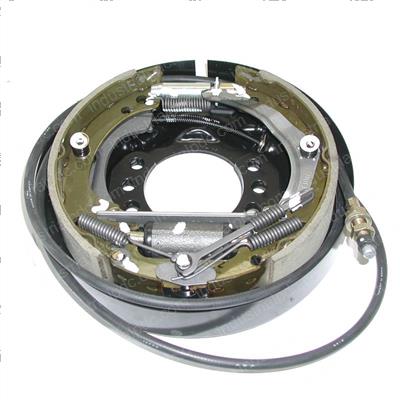
Forklift Drum Brakes: How They Work, What Fails and How to Diagnose It
Most internal combustion forklifts stop on drum brakes at the drive axle: one master cylinder feeding a wheel cylinder at each end, spreading two shoes against a drum. The shoes self-adjust, but on most designs only when the truck brakes in reverse. Three quarters of brake complaints come down to contaminated linings or adjustment, not worn parts.

Forklift Hydraulic Systems and Gear Pumps: How They Work and How to Diagnose Them
A forklift runs steering and lift/tilt from one pump and one tank. A flow control valve on the pump gives steering priority, passing it a fixed flow first and sending only the surplus to lift and tilt — which is why lift slows when you steer. Each circuit has its own relief valve in a different place, and adjusting the wrong one is the most common diagnostic mistake on these systems.

Forklift LPG fuel systems
An LPG forklift stores fuel as a liquid under pressure in a tank. A vacuum-operated fuel valve in the filter unit lets liquid reach the vaporizer only while the engine is being started or is running. The vaporizer, heated by engine coolant, drops the pressure and changes the liquid to vapor. The carburetor meters that vapor against airflow, and a governor limits engine speed.

Forklift Master Cylinders: How They Work and Why They Fail
A master cylinder converts pedal force into hydraulic pressure — force divided by piston area — and delivers it to the wheel cylinders or brake packs that stop the truck. Tandem units feed two isolated circuits, so losing one line still leaves working brakes. Most failures are internal: the pedal sinks under steady pressure with no visible leak.

Forklift masts and carriages
A forklift mast is a set of nested weldments that slide on load rollers and strip bearings, raised by lift cylinders and chains. The carriage carries the forks and rides in the inner weldment. The checks that matter are roller and bearing clearance, chain length and tension, and internal hydraulic leakage. Mast parts are heavy and can move, so the safety procedure must be followed.

Forklift steering axles
A forklift steering axle carries the steered wheels. It hangs from the frame on a center pivot pin so it can rotate as the truck travels over rough ground, and a hydraulic cylinder with a rod out of both ends pushes tie rods to swing two spindles on their king pins. Each spindle and each hub turns on a pair of tapered roller bearings.

Forklift tilt cylinders
A tilt cylinder is a double-acting hydraulic cylinder that tilts the mast. Oil behind the piston pushes the rod out and tilts the mast forward; oil in front of the piston pulls the rod back and tilts it backward. The number and design of the parts differ between trucks, but the operation is the same, and most repairs come down to renewing seals.

How an Alternator Works: Function, Maintenance and Troubleshooting
An alternator converts belt-driven mechanical energy into electrical current. The rotor spins a magnetic field past the stator windings to induce AC, the diode bridge rectifies it to DC, and the voltage regulator varies field current to hold output steady. The battery starts the engine; the alternator carries everything once it is running.
The Seven OSHA Forklift Classes
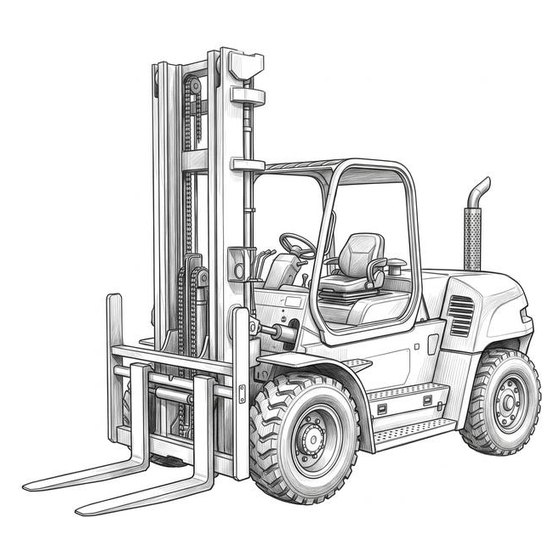
Every powered industrial truck falls into one of seven OSHA classes, sorted by power source, tire type and how the operator works the machine. Classes I–III are electric, IV and V are internal combustion on cushion and pneumatic tires, VI covers tractors and tow vehicles, and VII is rough terrain. The class tells you where a truck can run and which parts it consumes.