

This is a general, instructive guide to how the system works and what to look for. It is not a service manual, and it is not specific to your truck. Procedures, clearances, pressures, torque figures and service limits differ between makes, models and build dates, and the manual for the machine you are actually working on is the only authority on what is correct for it. Work to that manual, and to your employer's safety procedures.
What cushion and pneumatic actually mean
The most useful thing to understand about this choice is that it is mostly already made. A cushion truck and a pneumatic truck are different machines with different axles, different wheel mountings and different chassis geometry. You do not fit pneumatic tires to a cushion truck. So the real question is not which tire to buy, it is which surface the truck lives on — and that decides the truck.
Cushion tires
Solid rubber bonded to a base band, with no air in them at all. The common type is the press-on, where the band is pressed onto a bare wheel under a press; some trucks use bolt-on solids instead, which mount to a wheel with fasteners.
Because there is no air chamber and no sidewall, the whole tire and wheel package is small for the load it carries. That is what gives a cushion truck its defining characteristics: a short wheelbase, a tight turning radius and a low deck.
Pneumatic tires
Air-filled tires on a rim, with a deep tread and a real sidewall, much like a truck tire. The air and the tread depth do two things a cushion tire cannot: they absorb shock from broken ground, and they give the tire something to bite with on loose surfaces.
The cost is size. A pneumatic tire and rim capable of the same load is physically much bigger, which makes the truck longer, wider and taller for the same rated capacity.
Solid pneumatic
The compromise, and often the right answer. A solid rubber tire moulded in a pneumatic shape and fitted to a pneumatic rim. It gives most of the ground clearance and tread of an air tire with none of the punctures. It costs more than air, rides harder than air, and it fits a pneumatic truck — it is not a way to make a cushion truck work outdoors.
How they compare
| Cushion | Pneumatic | |
|---|---|---|
| Construction | Solid rubber on a base band | Air in a casing on a rim, or solid rubber in a pneumatic shape |
| Best surface | Smooth concrete and sealed asphalt | Gravel, broken asphalt, yards, dock aprons |
| Turning radius | Tighter, for narrow aisles | Wider, needs more room to work |
| Ground clearance | Low — debris and lips are a problem | Higher, clears uneven ground |
| Overall height | Lower, better under low doors and trailers | Taller for the same capacity |
| Ride | Firm; shock goes into the truck and the operator | Absorbs shock |
| Punctures | Impossible | Possible on air tires; impossible on solid pneumatic |
| Cost per tire | Lower | Higher, and higher again for solid pneumatic |
Choosing between them
Work through the surface first, then the space, then the risk.
- Surface. Smooth, sealed, swept floor: cushion. Anything the truck has to ride over rather than roll across — gravel, potholes, expansion joints, dock plates with a lip: pneumatic.
- Space. Narrow aisles and tight racking favour the cushion truck's turning radius. If the truck has to work in an aisle it barely fits, that usually settles it.
- Height. Low doorways, low trailer roofs and container work favour the lower cushion chassis.
- Debris. Nails, swarf, glass and broken pallet timber make air tires a running cost. Solid pneumatic exists for exactly this.
- Both, all day. Trucks that spend the shift going in and out are the hard case. Pneumatic usually wins, because a cushion truck on a rough yard beats itself and its operator apart, while a pneumatic truck indoors is merely bulky.
Fit the same type, tread and compound across an axle, and keep the pair matched for diameter. A worn tire on one side and a new one on the other puts the truck out of level, loads one side of the drive train and changes how the mast sits under load.
Tread and compound
Two choices sit on top of the cushion-or-pneumatic decision, and both affect the part number.
Smooth or traction tread
Smooth puts the maximum amount of rubber on the floor and wears the longest. It is the default for dry indoor concrete.
Traction tread has a moulded lug pattern that cuts through water and grip on ramps and damp floors. It wears faster and has less rubber in contact, so it is a deliberate trade rather than an upgrade.
Marking or non-marking
Marking tires are the standard black compound. Carbon black is what makes them black and it is also what makes them tough, so they last longer and cost less.
Non-marking tires leave the carbon black out, which is why they are grey or white. They do not stripe a clean floor, which matters in food, pharmaceutical, retail and clean-room work. In exchange they wear faster, cost more, and can build up static charge, so trucks working with sensitive electronics may need a discharge strap.
Specify non-marking only where the floor genuinely requires it. It is a real cost per hour, and it is often carried across a whole fleet when only the trucks working in one area need it.
Measuring a press-on cushion tire
Press-on tires are ordered by three dimensions, always in the same order: outside diameter, width, inside diameter.
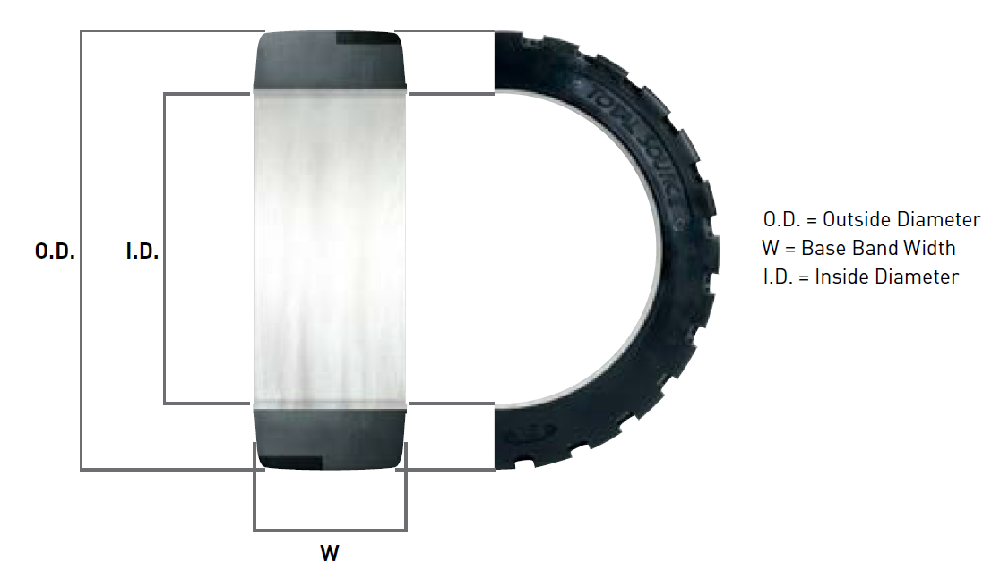
- O.D. — outside diameter
- Across the face, over the tread. This is the dimension that shrinks as the tire wears.
- W — width
- The width of the base band. This is the dimension catalogues are built on, so take it at the band rather than anywhere else on the tire.
- I.D. — inside diameter
- The bore of the band, which is the surface that grips the wheel. This is what decides whether the tire will press onto your wheel at all.
Outside diameter is the one dimension that changes in service. A worn tire measured off the truck will give an O.D. smaller than the size you need to order. The width and the inside diameter do not wear, so those two are reliable from the old tire — but get the O.D. from the old part number, the wheel, or an unworn matching tire wherever possible.
How the dimensions become a part number
Most suppliers build a press-on tire part number the same way: the three dimensions, then a letter for the tread, then a letter or pair for the compound.
- Dimensions
- O.D. × W × I.D., in inches
- Tread
- S for smooth, T for traction
- Compound
- M for marking, NM for non-marking
So a tire measuring 21 inches outside diameter, 7 inches wide, 15 inches inside diameter, with a smooth tread in a non-marking compound, reads as 21×7×15, S, NM. Suppliers prefix that string with their own code, but the dimensions and the two suffixes are consistent enough that a full measurement plus tread and compound will identify the tire with anyone.
When to replace a cushion tire
A solid tire gives less warning than an air tire because it cannot go flat. Watch for:
- Wear down toward the band. Most press-on tires carry a moulded line or a step in the sidewall marking the safe limit. Run past it and the band can contact the floor.
- Chunking. Pieces torn out of the tread, usually from debris or from a truck being run on a surface the tire was not chosen for.
- Cracking and separation. Splits at the bond line between rubber and band mean the tire is coming apart, and it will not stop.
- Flat spotting from skidding or from a truck standing in one place for months.
- A truck that suddenly rides worse or sits low on one corner. Cushion tires lose height as they wear, and an uneven pair changes how the truck handles a load.
Frequently asked questions
Can I put pneumatic tires on a cushion forklift?
No. They are different trucks. A cushion truck's axles, wheel mountings and chassis geometry are built around a small solid tire, and there is no pneumatic wheel that fits. If the surface has changed, the truck has to change, not the tire.
Which lasts longer, cushion or pneumatic?
On the surface each is built for, both do well, and the comparison is not really the useful one. What kills tires is using them on the wrong surface: a cushion tire chunks and cracks on broken ground, and an air tire punctures where there is debris. Choose for the surface and life takes care of itself.
What is the difference between pneumatic and solid pneumatic?
Shape and fitment are the same; what is inside is not. A pneumatic tire holds air; a solid pneumatic is rubber all the way through, moulded in the same profile and fitted to the same rim. Solid costs more and rides harder, but it cannot puncture, which pays for itself anywhere there is debris on the ground.
Do I really need non-marking tires?
Only where the floor requires it — food, pharmaceutical, retail, clean rooms. Non-marking compound leaves out the carbon black that makes a black tire tough, so it wears faster and costs more. It is worth specifying deliberately, per truck, rather than across a whole fleet by default.
How do I measure a press-on tire to order a replacement?
Three dimensions in this order: outside diameter across the tread, width of the base band, and inside diameter of the band bore. Take the width at the base band. Then note the tread pattern and whether the compound is marking or non-marking.
The old tire is worn. Can I still measure it?
For width and inside diameter, yes — neither changes in service. Outside diameter does, so a worn tire will measure undersize and ordering to that number gets you a tire smaller than the truck should have. Take the O.D. from the old part number, the wheel, or a matching unworn tire.
Do tires have to be replaced in pairs?
Across an axle, yes, and matched for type, tread, compound and diameter. Cushion tires lose diameter as they wear, so a new tire opposite a worn one puts the truck out of level, loads one side of the drive train and changes how the mast sits with a load on the forks.
Before you order
- Confirm the truck type first. Cushion and pneumatic are not interchangeable, so establish which machine you have before looking at tires at all.
- Measure all three dimensions on a press-on, taking the width at the base band.
- Get the outside diameter from something unworn — the old part number, the wheel, or a matching tire.
- Decide tread and compound deliberately. Smooth or traction, marking or non-marking, both change the part number and both have a running cost.
- Order in pairs per axle, matched.
- Check the wheels while the tires are off. Press-on tires are pressed onto a bare wheel, and a damaged or distorted band seat will not hold a new tire properly.
Not sure what you are measuring? Send us the three dimensions off the tire, the tread pattern, whether you need marking or non-marking, and the truck's data plate details, and we will match it before you order. If the old tire is worn past a reliable outside diameter, the old part number or the wheel will get us there.
This article is a general guide to choosing and measuring forklift tires. Load ratings, wear limits and approved tire types are set per truck by its manufacturer, and fitting a tire the truck is not rated for affects its capacity and its stability. As above, work to the data plate and the service data for your own machine.