
Engine

Forklift Carburetors: How They Work, What Fails and How to Adjust Them
A carburetor meters fuel into the engine's airflow using calibrated jets and mechanical linkage, with no sensors or feedback. Separate circuits handle idle, main running, full load, sudden acceleration and cold starting, all working from one constant fuel level in the float bowl. On a forklift the throttle pedal commands a governor, not the carburetor directly, and coolant is routed through the casting to stop the throttle plate icing.

Forklift LPG fuel systems
An LPG forklift stores fuel as a liquid under pressure in a tank. A vacuum-operated fuel valve in the filter unit lets liquid reach the vaporizer only while the engine is being started or is running. The vaporizer, heated by engine coolant, drops the pressure and changes the liquid to vapor. The carburetor meters that vapor against airflow, and a governor limits engine speed.

Mitsubishi 4G63 and 4G64 forklift engines
The 4G63 and 4G64 are Mitsubishi's 2.0 and 2.4 liter industrial spark-ignition engines, fitted to gas and LPG lift trucks under several brands. They share an architecture, iron block and aluminum head on a belt-driven camshaft, but every part set by displacement differs. Read the stamped engine number rather than the family designation, and confirm the fuel system separately.
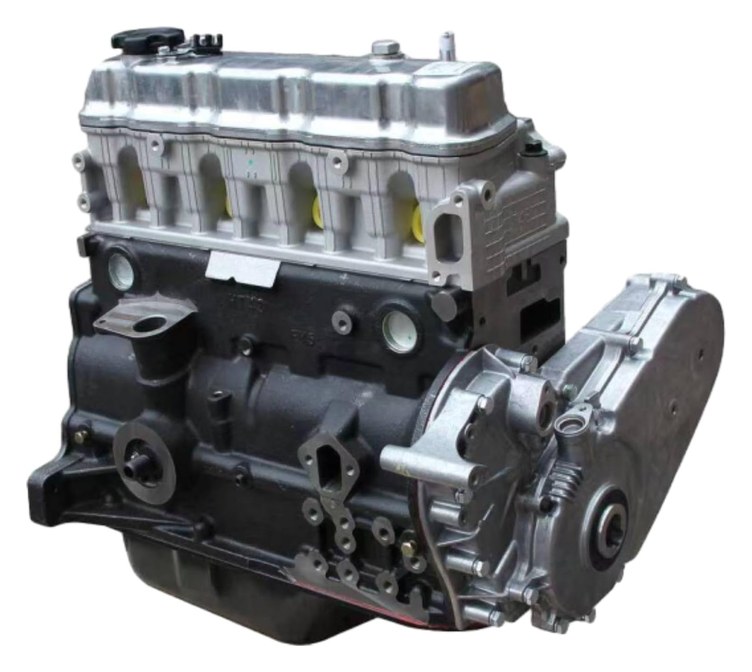
Nissan Forklift Engines: H20, H20-II, H25, K21 and K25 Explained
Nissan's H20, H20-II, H25, K21 and K25 power industrial equipment under many different OEM badges. The H-series is an iron pushrod design with a timing chain; the K-series is an aluminum-head overhead cam with a timing belt. The two families share essentially no parts, and matching displacement — H25 versus K25 — is not a cross-reference. A magnet on the cylinder head tells you which family you have.

Nissan K21 and K25 Engines Explained
The K21 and K25 are four-cylinder industrial engines sharing an 89 mm bore and differing in stroke, at 2,065 cc and 2,488 cc. Both use an overhead-valve pushrod valvetrain with a rocker shaft and screw adjusters, a bathtub combustion chamber, a timing chain, five main bearings and a chain-driven side power take-off. Both run gasoline or LPG.

Nissan K21 and K25 Maintenance and Troubleshooting
Routine service on a K21 or K25 covers valve clearance set hot at 0.38 mm on every valve, a cold retighten of the head bolts and manifold nuts, belt deflection, oil and filter, plugs, air and fuel filters and coolant. Most running complaints trace back to compression, ignition or fuel, and a compression test separates them quickly.