
This is a general, instructive guide to how the system works and what to look for. It is not a service manual, and it is not specific to your truck. Procedures, clearances, pressures, torque figures and service limits differ between makes, models and build dates, and the manual for the machine you are actually working on is the only authority on what is correct for it. Work to that manual, and to your employer's safety procedures.
These five designations cover a large share of the gas and LPG engines in industrial equipment, and they turn up under a lot of different paint. Nissan supplied these engines to numerous OEMs, so the badge on the counterweight tells you very little about what's under the cowl.
They fall into two distinct families, and the single most expensive mistake in this space is assuming that similar displacement means shared parts. It does not.
This guide covers what each engine is, where it was used, what wears out, and — in a dedicated section below — how to identify what's actually sitting in the truck.
The two families

H-series — the older iron pushrod engines
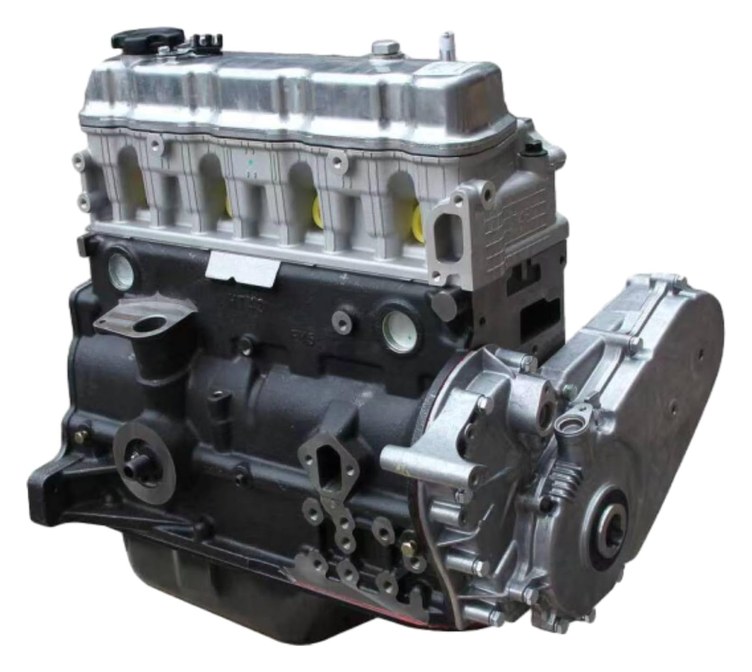
The H-series is a cast iron, overhead-valve pushrod design with a chain-driven camshaft. It's heavy, simple, tolerant of neglect, and rebuildable many times over. Nissan used it in industrial equipment from the 1960s until the K-series took over in the mid-2000s.
H20. Roughly 2.0 L, four cylinders, cast iron block and cast iron head. Timing chain, distributor ignition, mechanical valve lash adjustment, firing order 1-3-4-2. Industrial rating lands in the mid-40 hp range depending on governor setting and fuel.
The critical wrinkle: there are multiple H20 generations. You will see H20, H20-II and H20A in the field, often used interchangeably by people who shouldn't be using them interchangeably.
H20-II. A revised generation, not a trim level. The head casting, combustion chamber, manifold interface and front-of-engine accessories changed from the original H20. Practical rule: treat H20 and H20-II as separate parts catalogs. Heads, head gaskets, manifolds and ignition components are the usual mismatch points.
H25. Roughly 2.5 L. Same architecture as the H20 family — iron block, iron head, timing chain — with a larger bore and a substantially longer stroke. Output lands in the low-to-mid 50 hp range. Shares many ancillaries with the H20-II, but the block, crankshaft, pistons, rods and head gasket are all specific to it.
K-series — the mid-2007 replacement
The K-series entered production in mid-2007 and represents a full redesign, not an evolution. Key differences:
- Single overhead cam, belt-driven. The timing belt is a scheduled replacement item (commonly around 2,000 hours — confirm against the service manual for the specific truck). The H-series has no equivalent interval.
- Aluminum cylinder head. Different gasket design, different torque procedure, different thermal behavior — and an aluminum head on an iron block is far less forgiving of overheating.
- Later emissions compliance. Some later K25s moved to electronic fuel control, so the same engine designation can arrive with either a mechanical fuel system or a full electronic one.
K21. Roughly 2.1 L. Industrial rating in the mid-40s hp. Typical of trucks in the 3,000–4,000 lb capacity range.
K25. Roughly 2.5 L. Industrial rating in the 50–60 hp range. Typical of trucks in the 4,000–6,500 lb range, and the more common of the two in North America.
K21 and K25 are the same engine with a different stroke. Interchangeable between them: cylinder head, valvetrain, timing belt, water pump, oil pump, most gaskets and seals. Not interchangeable: crankshaft, pistons, connecting rods, head gasket, block.
Interchange between families: effectively none
This is worth stating plainly because it catches people constantly.
The H25 and K25 have the same displacement. They share almost no parts. Different block, different head, different head material, different timing drive, different oil pan, different manifolds, different accessory mounting, different fuel system architecture.
Matching displacement is not a cross-reference. Neither is the shared "Nissan 2.5" shorthand that shows up in listings and forum posts.
What fails
H-series
- Valve seats and guides. LPG burns hotter and provides no upper-cylinder lubrication, so seat recession is the classic propane-fleet failure on iron-head H engines. Hardened seats are effectively mandatory on rebuild for LPG duty.
- Timing chain, tensioner and guides. A rattle or slap on cold start is the tell.
- Head gasket, usually secondary to overheating from a tired water pump or a plugged radiator.
- Water pump.
- Ignition wear — points, cap and rotor on early units; module and pickup on later electronic setups.
- Governor assembly wear, showing up as surge or overspeed.
K-series
- Timing belt neglect. The single most avoidable K-series failure. Trucks get bought used and the belt interval never gets picked up.
- Head gasket and warped head. Aluminum head, iron block — overheating does more damage here than on an H.
- Water pump (belt-driven, so a failure can take the timing belt with it).
- Fuel system components on electronically controlled units — sensors, throttle body, and the electronic pressure regulator on LPG.
- Valve seat wear on LPG, though less severe than the H-series thanks to the redesigned head.
Where these engines show up
Nissan supplied these engines widely as OEM powerplants, so the same H20 or K25 can appear in equipment from a dozen different manufacturers. Corporate consolidation compounds this: Nissan Forklift and TCM combined into UniCarriers, which later came under Mitsubishi Logisnext, and Caterpillar's and Mitsubishi's lift truck operations were jointly held for decades. The practical consequence is that CAT and Mitsubishi gas trucks of the same era are frequently the same machine with different paint and different part numbers on the same engine.
OEM brands commonly using H- or K-series engines
- Nissan Forklift
- UniCarriers
- TCM
- Caterpillar (lift trucks — note this is CAT's material handling line, not CAT construction equipment)
- Mitsubishi Forklift
- Doosan
- Daewoo
- Barrett
Equipment categories beyond lift trucks
Both families were used well outside material handling:
- Airport ground support equipment — baggage tractors, belt loaders, pushback tugs
- Industrial sweepers and floor scrubbers
- Terminal and yard tractors
- Aerial work platforms and personnel lifts
- Stationary and portable power — generators, welders, pumps, compressors
- Various purpose-built and specialty industrial machines
How to identify which engine you have
Work through this in order. Step 1 narrows it down visually, Step 2 confirms it, and Step 3 covers the cases where the stamp is unreadable.
Step 1 — Determine the family: H or K
These checks are quick and don't require any disassembly.
Cylinder head material — the fastest test. Put a magnet on the cylinder head, not the block.
- Magnet sticks → cast iron head → H-series
- Magnet doesn't stick → aluminum head → K-series


Front of engine — chain or belt. A rigid cast timing cover integral to the front of the block, with no belt visible and no toothed pulleys, is H-series (chain). A toothed belt behind a removable cover, with a toothed camshaft sprocket, is K-series.
Valve cover. A tall pressed-steel cover housing a rocker shaft and pushrod gear is H-series. A cam cover sitting directly over an overhead camshaft is K-series.
Truck age as a weak signal. Pre-2007 leans H, 2007-and-later leans K. Useful for a first guess only — repowers and overlapping inventory make this unreliable on its own.
Step 2 — Read the engine number off the block
This is the authoritative source and it's worth the ten minutes it takes.
Where to look. A machined flat pad on the block, most commonly on the left (driver's) side toward the rear near the bellhousing flange, above the oil pan rail. Also check the flywheel end and the front of the block. Position varies by generation.
Getting it readable. These stamps are shallow and are usually buried under paint, grease and surface rust. Degrease, hit it with a brass or wire brush, then wipe with a light oil and shine a flashlight across it at a low angle — raking light makes shallow characters legible when direct light won't.
What to record. Write down the entire string, including all dashes and suffix letters, exactly as stamped. Format is generally the engine designation followed by a serial number. The suffix characters are frequently what distinguishes one generation from another, so an H20 recorded as "H20" when it's actually stamped "H20-II" defeats the whole exercise.
Step 3 — Cross-reference the truck data plate
Where. The nameplate on the dash cowl, or on a leg of the overhead guard.
What to record. Truck model code and truck serial number, both in full.
Why. Most OEM model codes encode series, capacity and fuel type, and the model-plus-serial combination cross-references in the parts manual to the engine the machine left the factory with. When the block stamp is gone or unreadable, this is the best available substitute.
Note that the data plate identifies the machine manufacturer, not the engine manufacturer. A CAT, Mitsubishi or Doosan plate is entirely consistent with a Nissan engine underneath.
The caveat that matters. The plate tells you what the factory installed, not what's in the truck today. On a 20-year-old machine that's a meaningful gap. Where the plate and the block stamp disagree, the block stamp wins.
Quick reference
| Observation | Conclusion |
|---|---|
| Magnet sticks to the head | H-series |
| Magnet doesn't stick to the head | K-series |
| Toothed timing belt | K-series |
| Tall pressed-steel valve cover, pushrods | H-series |
| Two iron engines, one noticeably taller | Taller is the H25 |
| Two aluminum-head engines, look identical | K21 vs K25 — read the stamp |
| Data plate and block stamp disagree | Trust the block stamp |
Not sure which engine you're working with? Send us the engine number stamp and the truck data plate and we'll confirm the correct parts before you order.