

This is a general, instructive guide to how the system works and what to look for. It is not a service manual, and it is not specific to your truck. Procedures, clearances, pressures, torque figures and service limits differ between makes, models and build dates, and the manual for the machine you are actually working on is the only authority on what is correct for it. Work to that manual, and to your employer's safety procedures. The illustrations show one manufacturer's design; there are many, so read them as examples of the arrangement rather than as a picture of your machine.
How a tilt cylinder works
Tilt cylinders are the simplest hydraulic component on a forklift and the one with the widest variety of internal designs. The number and the design of the parts differ enormously from one truck to the next. What they do does not change at all.
A tilt cylinder is double-acting: it is driven under pressure in both directions rather than relying on gravity to return. Oil entering the port behind the piston pushes the rod out of the shell, which tilts the mast forward, and the oil in front of the piston returns to the tank. Oil entering the port in front of the piston pushes the rod back into the shell, which tilts the mast backward, and the oil behind the piston returns to tank.
Because the load can drive the mast forward as well, a tilt cylinder holds position purely on trapped oil and the integrity of its seals. That is why an internal seal leak shows up as the mast creeping forward with the lever in neutral, and it is why the test for it is a timed measurement rather than a look for a wet patch.
Seal designs you will meet
Cylinders are grouped here by what you can see when you take one apart, because that is the only thing that helps at the bench. The differences matter: seal kits do not cross between them, and the way the cylinder comes apart is different in each case.
Threaded retainer with a screwed-in gland
The commonest arrangement. The rod carries a piston held by a nut, and a threaded retainer screws into the end of the shell to close it and guide the rod. The piston carries an O-ring, a seal ring and a guide ring; the retainer carries a rod seal, a wiper ring and an O-ring where it meets the shell, sometimes with a back-up ring behind it.
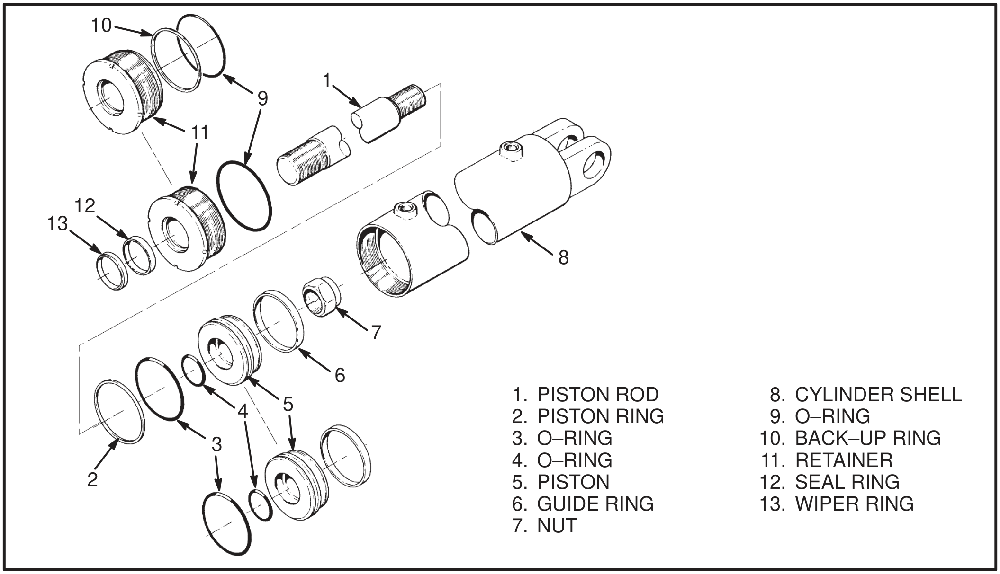
On cylinders of this type the O-ring that seals the retainer to the shell is found in two different places. On some it sits above the threads; on others it sits below them, with a back-up ring added behind it for strength. Assembly is the same either way, but where the O-ring has to pass over the threads on its way in, it is easily cut. Check which arrangement yours is before you buy a kit, and take your time getting the retainer started.
Lock ring retained in the shell
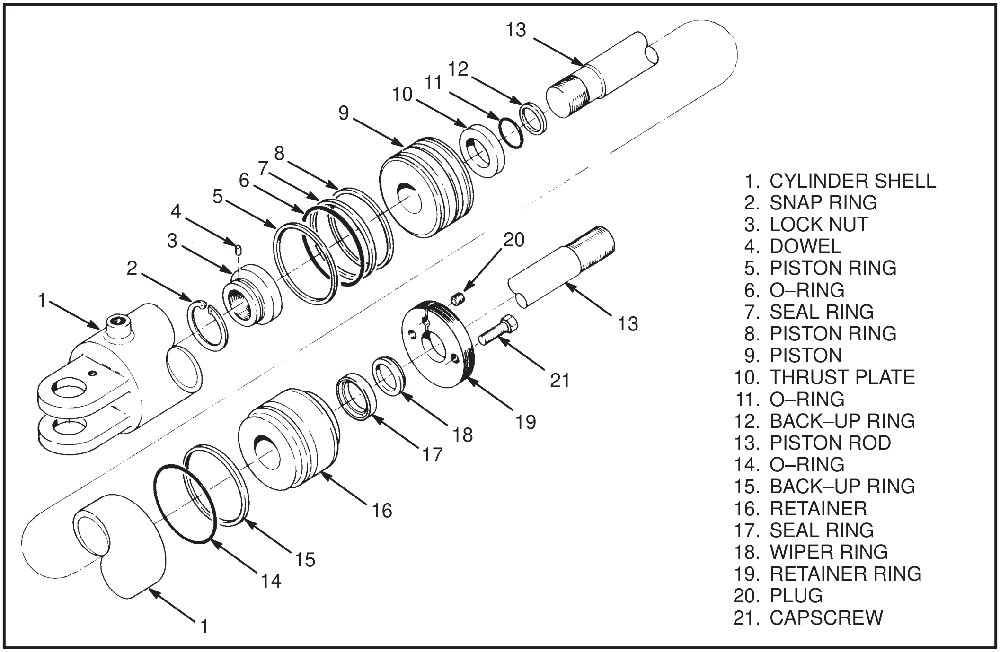
A heavier arrangement, used where the retainer is not threaded into the shell. The rod carries a thrust plate held by a lock nut, which is itself locked by a pin and a snap ring; on some the hole for that pin is drilled at assembly. The retainer slides into the shell and is held by a separate lock ring, secured with capscrews and closed off by a pipe plug. Getting the lock ring level with the end of the shell before the plug and capscrews go in is the part that catches people out.
Chevron packing
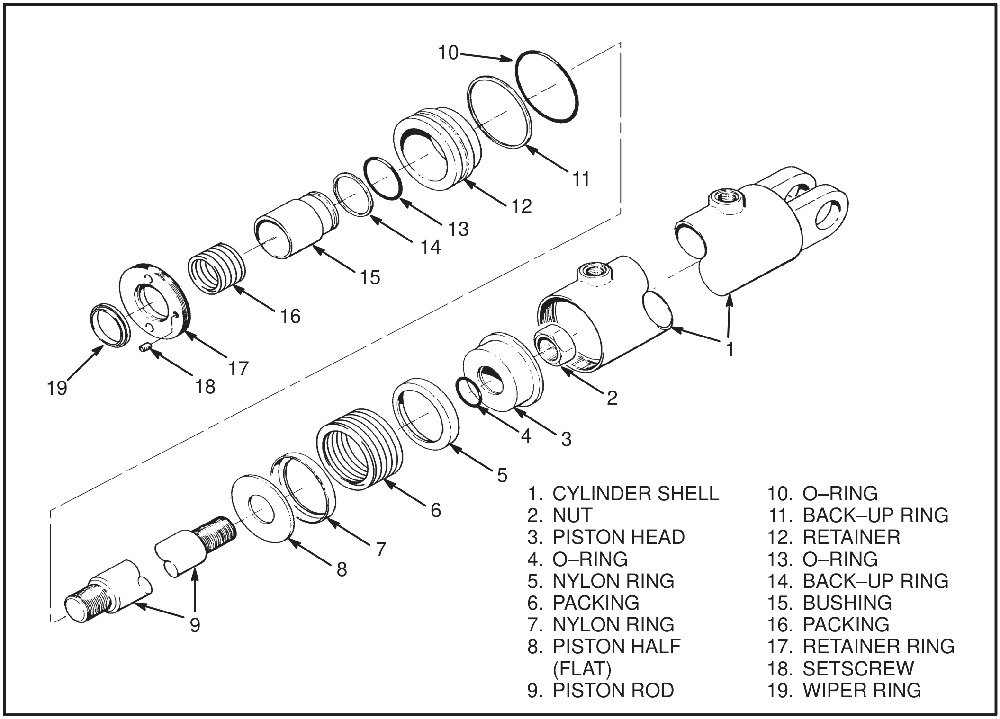
The oldest of the arrangements and the one that behaves least like a modern seal kit. Instead of a one-piece piston with an O-ring, the piston is split into two halves — a flat half and a half that carries the packing — and the seal is a stack of V-shaped chevron rings rather than an elastomer ring. The rod is sealed by more packing inside a bushing, which sits inside the retainer and is held by a retainer ring and a setscrew.
What wears out and what fails
- Rod seals and wiper rings. The wiper keeps grit off the rod; when it goes, the rod seal follows.
- Piston seals, seal rings and packings. These are what stop the mast drifting, and they are the reason for most rebuilds.
- O-rings and back-up rings, both on the piston and where the retainer meets the shell.
- Guide rings and nylon rings, which keep the piston centered in the bore.
- The cylinder bore. Inspected for damage every time seals are replaced — a scored bore will destroy a new seal.
- The rod. Pitting or scoring under the wiper will cut a new rod seal quickly.
- Anchor pins and their retainers, at the frame end and the mast end.
Removing a tilt cylinder safely
Before removing a tilt cylinder, tilt the mast forward and chain the mast to the frame so it cannot move forward. Taking the cylinders off is taking away what holds the mast back. Do not push the anchor pins out of the rod end with your fingers — use a tool. Do not let a tilt cylinder drop.
The sequence is short: disconnect the hydraulic lines and cap both the lines and the ports, remove the retainers and drive the anchor pins out of the rod end, then remove the anchor pins at the frame anchors and take the cylinder out. Large cylinders are heavy enough to need a lifting device rather than a pair of hands.
At the bench, the cylinder goes into a vise with soft jaws, the rod end comes off the rod, then the retainer comes out and the rod and piston come out of the shell.
Rebuilding
Cleaning solvents can be flammable and toxic and can cause skin irritation; follow the solvent manufacturer's recommended safety procedures. Compressed air can throw particles hard enough to injure you or someone nearby. Keep the air directed away from people and wear goggles or a face shield.
Clean everything in solvent and dry with compressed air. Then three rules apply whatever the design: always fit new seals and O-rings, make sure every part is clean, and lubricate everything with clean hydraulic oil as it goes together.
Heated seal rings
Some piston seal rings will not stretch over the piston cold. These are heated first, then pushed into their groove with a ring compressor, and left to cool so they shrink back to their normal shape and size before the piston goes anywhere near the bore. Skipping the cooling step means forcing an oversized ring into the bore and cutting it.
Getting the seals the right way round
Orientation matters more than it looks. A rod seal of the O-ring type goes in with the O-ring facing the piston. Chevron packing is directional by its shape. And when a retainer with an O-ring on it is threaded into the shell, the O-ring has to pass the threads without being nicked.
Chevron packing
Packing takes more care than a seal kit. The O-ring and back-up ring go on the bushing first, then the packing goes into the bushing, and the end of the packing must stand proud of the end of the bushing by about 3 mm (1/8 in) — that projection is what gets compressed into a seal when the retainer is tightened. The retainer takes its own O-ring and back-up ring, and the bushing is pushed into it by hand.
At the piston, the flat half goes on the rod first, the O-ring sits on the rod halfway between the threads and that half, and the packing half follows, with the O-ring seating into the piston groove as it closes up. The rod nut goes on last.
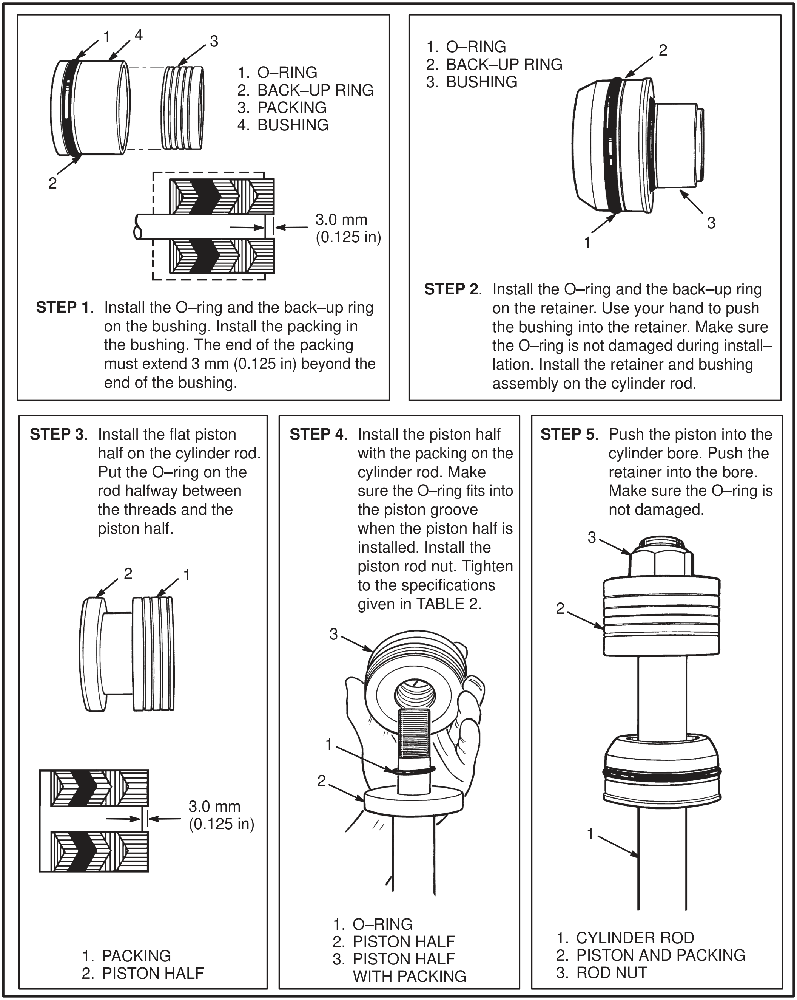
Finish by fitting a new wiper seal in the retainer, turning the retainer into the shell only until the threads have started, and pushing the piston in and out several times to prove the alignment before tightening anything. The retainer is then torqued and its setscrew locked.
Refitting
Put the cylinder back with a lifting device if it is a large one. Fit the anchor pin at the frame, then the anchor pin at the mast mount, with their retainer or cotter pins. Connect the lines, operate the cylinders, and check for correct operation and leakage before the truck goes back to work. The tilt stroke and the mast tilt angle are then set as part of the mast adjustment, not at the cylinder.
Checking for internal leakage
Never allow anyone under a raised carriage, and do not put any part of your body in or through the lift mechanism unless the mast is completely lowered and the engine is stopped. Do not look for hydraulic leaks by running a hand over pressurised components — oil at working pressure can be injected through the skin.
The test is a timed measurement, because the cylinder is being asked to hold rather than to move.
- Put a capacity load on the forks and chain the load to the carriage so it cannot fall.
- Raise the load a couple of metres and put the mast vertical.
- Measure how far the rod stands out of the shell, wait five or ten minutes, and measure again.
- Multiply the permitted rate for your truck by the time you waited, and compare.
Permitted drift is quoted against oil temperature, and the allowance with hot oil is several times the allowance with cold oil. A reading taken without knowing the oil temperature does not mean anything. Use the rate table in the service data for your own truck.
If the cylinder is over its rate, the next step separates the cylinder from everything upstream of it. Lower the mast, take the load off, and fit a shut-off valve between the port at the front of the tilt cylinder and the hydraulic line. Load the forks again and close the valve, then tilt the mast forward just past vertical.
- The mast keeps creeping forward with the valve closed. The oil has nowhere to go but past the piston, so the piston seals are leaking.
- The mast does not move with the valve closed, but does when you open it. The cylinder is holding. Look for leaks in the lines and fittings, and if there are none, suspect a worn or damaged main control valve.
Take the load off the forks as soon as the checks are finished.
Troubleshooting
| Symptom | Possible cause | Procedure or action |
|---|---|---|
| Tilt cylinder movement is slow, or not smooth | Air is in the hydraulic system | Remove the air from the hydraulic system. |
| The hydraulic pump is worn or damaged | Repair or replace the hydraulic pump. | |
| Restriction in the hydraulic lines | Repair the hydraulic lines. | |
| Seals in the tilt cylinder are damaged | Replace the seals, and inspect the cylinder bore for damage. | |
| The tilt cylinders have internal damage | Repair or replace the cylinder. | |
| Load is greater than capacity | Reduce the load. | |
| Pressure relief valve is not adjusted correctly, or is damaged | Repair or adjust the relief valve. | |
| Large leaks between the spool and its bore | Replace the valve section. | |
| The spool is not fully extended or retracted | Adjust the linkage to the spool. | |
| The tilt control spool is damaged | Repair the control valve. | |
| The mast moves with the tilt control lever in neutral | There are leaks in the hydraulic lines | Tighten the fittings, or repair the leaks. |
| Seals in the tilt cylinder are damaged | Replace the seals, and inspect the cylinder bore for damage. | |
| The tilt cylinders have internal damage | Repair or replace the cylinder. | |
| The tilt control spool is damaged | Repair the control valve. |
Frequently asked questions
The mast tilts forward slowly on its own. Is that the cylinder?
Not necessarily, and there is a test that settles it. Fit a shut-off valve between the port at the front of the cylinder and the line, load the forks, close the valve and tilt just past vertical. If the mast still creeps, the oil is going past the piston and the piston seals are the fault. If it holds with the valve closed and creeps with it open, the cylinder is fine and the leak is in the lines, the fittings or the main control valve.
How much drift is acceptable?
That depends on the truck and, just as much, on the oil temperature — the allowance with hot oil is several times the cold figure. Measure how far the rod moves over five or ten minutes with a capacity load and the mast vertical, then compare against the rate in your own service data for the temperature you tested at.
What has to be done before a tilt cylinder comes off?
Tilt the mast forward and chain it to the frame so it cannot move forward. The tilt cylinders are what hold the mast back, so once they are disconnected there is nothing restraining it. Cap the lines and the ports as they come apart, drive the anchor pins out with a tool rather than a finger, and support the cylinder so it cannot drop.
Why will the new seal ring not fit over the piston?
Some are not meant to, cold. That type is heated first, pushed into its groove with a ring compressor, and then left to cool so it shrinks back to size before the piston goes into the bore. If you fit one hot and assemble straight away, you are pushing an oversized ring into the bore and it will be damaged.
How far should chevron packing stand out of the bushing?
About 3 mm (1/8 in) beyond the end of the bushing. That projection is deliberate: it is what gets compressed into a working seal as the retainer is tightened. Packing fitted flush will not seal.
Can I set the tilt angle at the cylinder?
The adjustment is made at the rod ends, but it belongs to the mast procedure rather than the cylinder rebuild, because both cylinders have to end up with the same stroke and no twist in the mast weldments. Rebuild the cylinder, refit it, then set stroke and angle as part of adjusting the mast.
Do I need to replace the cylinder if the bore is scored?
Inspect it every time the seals come out, because a scored bore will cut a new seal and put you straight back where you started. Light marking may clean up; damage you can catch a fingernail in will not, and the cylinder is repaired or replaced instead.
Before you order
- Identify the design before ordering seals. Threaded retainer, lock ring, or chevron packing — nothing crosses between them. Look at how the retainer is held in the shell; that tells you which family you have.
- On threaded-retainer cylinders, check where the shell O-ring sits, above the threads or below them with a back-up ring. The kits are not the same.
- Order the complete set — rod seal, wiper, piston seal or packing, guide and nylon rings, O-rings and back-up rings. Everything comes out in one job.
- Anchor pins and their retainer or cotter pins are separate items and are worth renewing while the cylinder is out.
- Cylinders are supplied in pairs on most trucks. If one has failed through age rather than damage, the other is the same age.
- Measure before you order a complete cylinder: bore, rod diameter, closed length, stroke, and the pin sizes at each end.
We stock tilt cylinder seal kits, chevron packing sets, complete cylinders, anchor pins and rod ends across the common forklift ranges. Send us the truck's serial number, and if you have the cylinder off, the bore and rod diameters and how the retainer is held in the shell, and we will match it before you order.
This article describes how forklift tilt cylinders work, the main internal designs, and how they are checked and rebuilt. Drift rates, torque figures and seal arrangements vary between trucks and between cylinder designs on the same truck. As above, work to the service data for your own machine, and chain the mast before removing anything that holds it.