
This is a general, instructive guide to how the system works and what to look for. It is not a service manual, and it is not specific to your truck. Procedures, clearances, pressures, torque figures and service limits differ between makes, models and build dates, and the manual for the machine you are actually working on is the only authority on what is correct for it. Work to that manual, and to your employer's safety procedures.
Most internal combustion forklifts up to around 8,000 lb capacity stop on drum brakes at the drive axle. The design has barely changed in fifty years, which is the point — it is cheap, tolerant of abuse, and rebuildable with hand tools. It is also widely misdiagnosed, because three quarters of the complaints come from contamination and adjustment rather than from worn parts.
This covers the system as a whole. For the hydraulics in detail — bore sizing, cup seals, internal bypass — see the master cylinder guide.
Brake linings on older equipment contain fibres that are a cancer and lung disease hazard. Never clean brake parts with compressed air or a brush, and never sand, grind, chisel or hammer a lining. Wet the dust with an approved brake cleaning solvent first, bag the rags while they are still wet, and label the bag. Approved vacuum equipment or the wet method — there is no third option.
How the system works
The layout
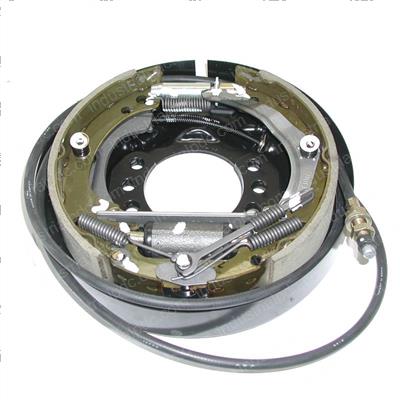
One service brake assembly at each end of the drive axle, both fed from a single master cylinder. Inside each assembly: a back plate carrying a wheel cylinder at the top, two shoes with bonded or riveted linings, an anchor at one end, return springs, and an adjuster screw assembly spanning the shoes at the bottom. A drum fits over the whole thing, and the hub and drum may be separate castings or a single one-piece unit depending on production date.
Press the pedal and hydraulic pressure pushes the wheel cylinder pistons apart. The pistons spread the shoes outward against the drum. Release, and the return springs pull the shoes back off the friction surface.
The wheel cylinder
A bore with a piston, cup seal, spring and rubber boot at each end. That is the entire part. It is cheap to rebuild and cheap to replace, and the decision between the two comes down to the bore: any pitting, scoring or corrosion inside it and a new cup will not seal for long. Fluid weeping past a boot is the visible failure. Fluid disappearing from the reservoir with no visible leak, on a system where the master cylinder holds pressure, usually means it is running down the inside of a back plate and soaking into a lining.
Shoes, linings and drums
The two shoes in an assembly are not equivalent. The primary — or leading — shoe does more of the work and wears faster, which is why shoes are replaced in complete sets, both sides of the axle at once. Replacing one side gives you a truck that pulls under braking, and pulling is one of the harder complaints to chase afterwards.
Linings fail three ways. They wear thin, they glaze hard from heat, or they get contaminated. Contamination is the common one: hub seal failure puts gear oil on the linings, a wheel cylinder puts brake fluid on them, and a washdown puts water on them. Contaminated linings cannot be cleaned back to service — the oil is in the friction material, not on it. They get replaced.
Drums wear too, and a drum that has worn or been machined oversize does two things: it moves the shoes further out to reach it, and it sheds heat worse because the wall is thinner. Every drum has a maximum inside diameter cast or stamped on it, or listed in the service data, and it is the limit including all wear — not just what you machined off.
The automatic adjuster
Shoe-to-drum clearance closes up automatically as the linings wear, through a linkage that indexes an adjuster wheel a fraction of a turn at a time. Two things about it are worth knowing, because between them they explain most "the self-adjusters are broken" calls.
On most designs the adjuster only indexes when the truck brakes in reverse. The shoe and adjuster link move with the drum during a stop, and only one direction of rotation produces the motion that turns the wheel. A truck that spends its day braking forward will drift out of adjustment no matter how healthy the mechanism is.
The adjuster can only turn if there is clearance to take up. Set the shoes too tight during a rebuild and the mechanism is locked out from the start — and it wears its own adjuster wheel rapidly while trying. Too loose and neither the brakes nor the adjuster work properly. The initial manual adjustment matters more than people expect.
The parking brake
There is usually no separate parking brake mechanism. Pulling the lever rotates cranks that pull a cable to levers mounted on the service brake shoes, and those levers push the same shoes against the same drum. The linkage is normally arranged so cable tension equalises between the two sides on its own.
This has a direct diagnostic consequence: the parking brake can never be better than the service brake adjustment underneath it. Adjusting parking brake cables to cure a parking brake that will not hold, before checking service brake adjustment and lining condition, is the most common wasted hour in forklift brake work.
The inching pedal — the forklift-specific part
On many powershift trucks the inching pedal acts on the same master cylinder push rod as the brake pedal. Pressing it declutches the transmission and begins applying the brakes, with a specified overlap between the two actions so the operator can hold the truck still against the drive while feathering hydraulics.
There is no automotive equivalent, and it means brake complaints and transmission complaints can each present as the other. A truck that creeps against the brakes, or one whose clutches will not fully release, may have a pedal linkage or push rod problem rather than anything wrong with either system.
What actually goes wrong
Contamination, far more often than wear
Look at the fault table further down and count how many times oil, water or brake fluid on the linings appears as a cause. It runs through nearly every symptom. When a brake complaint comes in, the drum comes off and the linings get looked at before anything is measured.
Adjustment, and the compensator port trap
Brakes that drag worse the longer the truck works are the signature of a blocked compensator port. If push rod clearance at the master cylinder has been adjusted out, the piston never fully retracts, the port stays covered, and fluid that expands as the brakes heat cannot vent back to the reservoir. Pressure climbs, the shoes stay applied, more heat, more expansion. No parts are needed — the fix is restoring clearance to the manufacturer's figure. It is a small number, typically around a millimetre at the cylinder, and it is specified per truck.
Handedness on reassembly
Drum brake assemblies are mirror images, and several parts are handed in ways that are not obvious on a bench:
- Return springs are often not identical between shoes, and the placement can be diagonal — one colour on the front shoe of one side and the rear shoe of the other. Photograph or note positions during teardown.
- Adjuster screw assemblies use left-hand and right-hand threads and are marked for which side they belong to. Fitted to the wrong side, the automatic adjuster retracts the shoes instead of expanding them.
- Pivot plates and links are frequently marked L and R, or differ subtly in shape.
None of this shows up until the truck is back together and the brakes behave strangely.
Heat
Drums are a heat sink with limited capacity. A truck working ramps, or one whose brakes have been dragging, cooks the linings hard and glazed and can crack a drum. Glazed linings feel like a hard pedal with poor stopping, which reads as a hydraulic fault and is not one.
Measuring and limits
Numbers are model-specific, so work from the service data for the truck in front of you. What to check, and why:
- Drum inside diameter
- Against the maximum listed for the drum, which includes all wear, not just what a machine shop removed. Also check for taper and out-of-round, either of which causes pulsation or pull.
- Maximum material removed by grinding
- A separate, smaller figure than the diameter limit. Measure before machining.
- Lining thickness
- To the minimum in the service data, or to the rivet heads on riveted linings.
- Push rod clearance at the master cylinder
- Small and critical. Too little closes the compensator port and drags the brakes; too much gives a long pedal.
- Pedal height above the floor plate
- Set before push rod clearance, since it changes the geometry.
- Parking brake holding grade
- Commonly the truck plus a capacity load on a 15% slope. Test it loaded, not empty.
- Wheel bearing preload
- Disturbed whenever a hub comes off for drum work, and over-tight bearings present as a brake that will not release.
Bleeding
Adjust the shoes first. Bleeding a system with the shoes out of adjustment wastes fluid and gives a soft pedal at the end of it anyway.
Fill the reservoir. Run a hose from the wheel cylinder bleed fitting into a clear container holding enough fluid to cover the hose end. Crack the fitting one turn, push the pedal slowly and hold it at the bottom of the stroke, close the fitting, then release the pedal. Closing before releasing is the part people skip, and skipping it draws air back in. Repeat until no bubbles appear, watching the reservoir level throughout, then do the other side.
If the pedal is still soft with both wheel cylinders running clear, the air is in the master cylinder. Push and release the pedal slowly and repeatedly until no bubbles rise into the reservoir.
Troubleshooting
Work from the symptom.
| Symptom | Likely cause |
|---|---|
| The brakes do not pull equally | Oil or brake fluid on the linings |
| Linings worn, or glazed hard | |
| Wheel cylinder damaged | |
| Restriction in a brake line | |
| Brake shoe or back plate damaged | |
| Drum out of round | |
| One brake will not release | Shoes adjusted too tight |
| Brake shoe damaged | |
| Return spring damaged | |
| Restriction in a brake line | |
| Parking brake cable damaged | |
| Wheel bearings adjusted too tight | |
| Wheel cylinder damaged | |
| Back plate damaged | |
| Both brakes will not release | Parking brake not fully released |
| Not enough push rod clearance at the pedal | |
| Master cylinder damaged | |
| Shoes adjusted too tight | |
| Seals swollen by oil contamination in the brake fluid | |
| Pedal is hard to push | Not enough clearance at the push rod |
| Linings too hard | |
| Water or oil on the linings | |
| Master cylinder damaged | |
| Wheel cylinder damaged | |
| Pedal return spring damaged | |
| Pedal feels soft, not enough resistance | Air in the brake system |
| Master cylinder mount loose | |
| Brake shoe damaged | |
| Drum cracked | |
| Back plate damaged | |
| Wheel cylinder damaged | |
| Linings do not match the drum radius | |
| Pedal travels too far | Air in the brake system |
| Shoes adjusted wrong | |
| Linings worn | |
| Too much clearance at the push rod | |
| Pedal sinks to the floor | Air in the brake system |
| Master cylinder damaged | |
| Leak somewhere in the system | |
| Brakes are noisy | Oil, water or brake fluid on the linings |
| Linings worn | |
| Drum damaged | |
| Brake shoe damaged | |
| Dirt on the linings | |
| Brakes will not stop the truck | Oil, water or brake fluid on the linings |
| Linings worn | |
| Wheel cylinder damaged | |
| Shoes not adjusted correctly | |
| Master cylinder damaged | |
| Parking brake will not hold | Oil, water or brake fluid on the linings |
| Parking brake cables not adjusted correctly | |
| Parking brake cable damaged | |
| Linings worn | |
| Parking brake will not release | Parking brake lever adjusted too tight |
| Parking brake cables damaged |
Frequently asked questions
Why do the brakes drag only after the truck has been working a while?
The compensator port in the master cylinder is being held closed. If push rod clearance has been adjusted out, the piston never fully retracts, the port stays covered, and fluid expanding from brake heat cannot return to the reservoir. Pressure builds and the shoes stay applied, which makes more heat. Restoring push rod clearance to the specified figure fixes it, and no parts are involved.
The automatic adjusters do not seem to work. Are they faulty?
Check two things before condemning them. Most designs only index when the truck brakes while travelling in reverse, so a truck that mostly brakes going forward will drift out of adjustment regardless. And the adjuster cannot turn at all if the shoes were set too tight during a rebuild — that locks the mechanism out and wears the adjuster wheel while it tries.
Can contaminated linings be cleaned and reused?
No. Oil and brake fluid soak into the friction material rather than sitting on the surface, so cleaning the face does nothing. Replace them, and fix the source first — a hub seal or wheel cylinder that is still leaking will contaminate the new set too.
Do I have to replace brake shoes in sets?
Yes, both sides of the axle at once. The primary shoe wears faster than the secondary, and lining thickness differences between the two sides make the truck pull under braking. A pulling truck is harder to diagnose after the fact than it would have been to do the second side at the time.
The parking brake will not hold. Should I adjust the cables?
Not first. The parking brake applies the service brake shoes through added linkage, so it can only be as good as the service brake adjustment and the lining condition underneath it. Adjust the service brakes, confirm the automatic adjuster is working and the linings are clean, then adjust cables if it still will not hold — and test it loaded on a grade, not empty on the flat.
Why does my brake pedal affect the transmission?
On many powershift forklifts the inching pedal shares the master cylinder push rod with the brake pedal, so declutching and braking are mechanically linked with a specified overlap between them. That means a brake pedal geometry problem can present as a transmission fault and vice versa. Check push rod clearance and pedal height before pulling anything apart.
Is the brake dust really dangerous on a forklift?
On older equipment, yes — the linings can contain fibres that are a cancer and lung disease hazard, and the dust inside a drum is exactly the respirable size that matters. Never blow a drum out with compressed air. Wet the dust with an approved brake cleaner, bag the rags wet, and label the bag.
Before you order parts
A full drum brake overhaul on one axle typically means shoes in a complete set, wheel cylinder kits or complete cylinders for both sides, return and retainer springs, an adjuster wheel assembly per side, hub seals, and brake fluid. Add a master cylinder kit if the pedal will not hold under steady pressure, and drums if they are at or past their diameter limit.
Because springs, links and adjuster assemblies are frequently handed, have the truck make, model and serial number to hand when ordering — the left and right parts often carry different numbers.