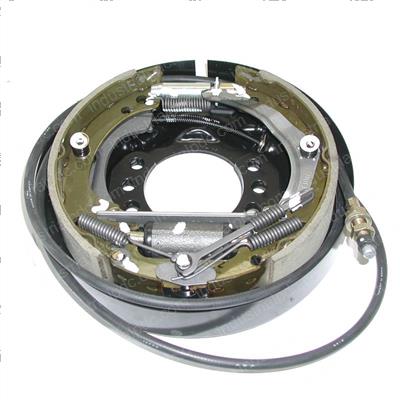
Most internal combustion forklifts stop on drum brakes at the drive axle: one master cylinder feeding a wheel cylinder at each end, spreading two shoes against a drum. The shoes self-adjust, but on most designs only when the truck brakes in reverse. Three quarters of brake complaints come down to contaminated linings or adjustment, not worn parts.
A forklift cooling system is a pressurised loop of water and antifreeze moved by a belt-driven water pump, regulated by a wax-pellet thermostat and cooled by a fan through the radiator. On powershift trucks the same radiator also cools transmission oil, so overheating is a whole-truck problem. The radiator cap holds pressure to raise the coolant's boiling point — a weak cap causes overheating on its own.
A carburetor meters fuel into the engine's airflow using calibrated jets and mechanical linkage, with no sensors or feedback. Separate circuits handle idle, main running, full load, sudden acceleration and cold starting, all working from one constant fuel level in the float bowl. On a forklift the throttle pedal commands a governor, not the carburetor directly, and coolant is routed through the casting to stop the throttle plate icing.
A forklift runs steering and lift/tilt from one pump and one tank. A flow control valve on the pump gives steering priority, passing it a fixed flow first and sending only the surplus to lift and tilt — which is why lift slows when you steer. Each circuit has its own relief valve in a different place, and adjusting the wrong one is the most common diagnostic mistake on these systems.
Inch fastener strength is shown by radial lines on the head — none for Grade 2, three for Grade 5, six for Grade 8. Metric strength is a printed property class such as 8.8 or 10.9, where the number is the strength written out: 8.8 means roughly 800 MPa tensile and 640 MPa yield. A replacement must be equal or greater strength and the correct size, and the nut grade has to match the bolt.